
Watering Your Lawn in Summer — How Much, When and How
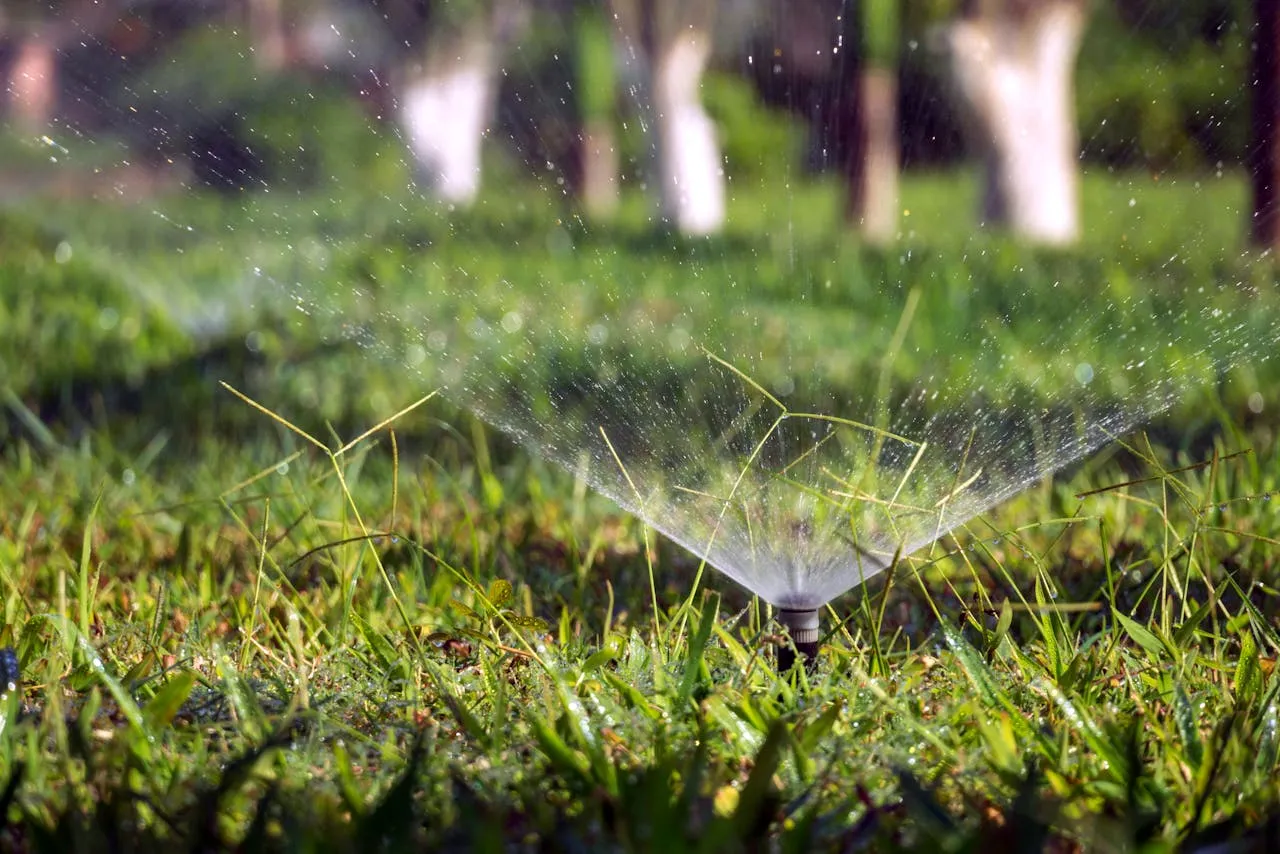
In short: in summer a lawn needs about 25 mm of water a week in total, rain included, given in two deeper waterings rather than a short daily sprinkle. Water early in the morning, roughly between four and nine, and check the amount with tins and a screwdriver — if the screwdriver goes in easily to 15–20 cm, you have watered enough. During a heatwave do not switch to daily sprinkling; at most add one extra watering while the heat lasts.
Why water a lawn deeply and infrequently rather than every day?
The most common mistake in July and August is not too little water, but the wrong rhythm. A short sprinkle every evening wets only the top layer of soil, and the grass behaves exactly as you have taught it to: the roots stay shallow, in the zone that dries out first. The moment you skip a day or two, the lawn turns yellow, even though you have technically been watering it regularly.
Deeper watering does the opposite. The water penetrates to the zone where the roots can draw on it for days, and between waterings the top layer dries out, which drives the roots downwards. A lawn like that copes far more calmly with heat and with gaps in watering.
How much water does a lawn need each week in summer?
For our summer conditions, reckon on around 25 mm of water per week in total, which is 25 litres per square metre. Split that amount into two deeper waterings, rather than five or seven short ones. So roughly 12 to 13 mm per watering, with a few days in between.
The chernozem of Srem on the loess terrace helps here. It is a loam, a silty loam, a soil that takes water up evenly and holds it for a decent length of time. Water does not drain straight through as it would through sand, but nor does it sit on the surface as it does on heavy clay ground. If you notice water running down a slope before it soaks in, split the watering into two passes with a break of twenty minutes or so.
How do you check the water has reached the roots?
You do not need any equipment. Place a few empty tins or shallow jars of the same height around the lawn, run the watering, and time how long it takes for about 12 mm of water to collect in them. That time is your measure, and at the same time it shows you whether some parts of the lawn are getting considerably less than the rest.
Do the second check an hour after watering: push a screwdriver or a long garden fork into the soil. If it goes in easily to 15 or 20 centimetres, you have watered enough. If it stops at five centimetres, the water has gone no further than the surface, and next time you need to water for longer, not more often.
Why water early in the morning?
The best slot is early morning, roughly between four and nine o'clock. The temperature is low then and the air is still calm, so almost all the water ends up in the soil.
Watering at midday is largely lost to evaporation. High temperatures and a dry summer wind carry off a good part of the water while it is still in the air or on the leaf, before it reaches the root zone, so you are left with the impression that you have watered while the soil underneath stays dry.
Evening watering seems logical, but it brings a real problem: the leaf stays wet all night, and warm, damp foliage is ideal for fungal diseases. If your schedule only allows the evening, water as early as you can, while there are still two or three hours of daylight for the grass to dry off.
Does rain count towards the weekly total?
Those 25 mm are the total amount, not something to add on top of rainfall. Put a simple rain gauge in an open spot in the garden and keep an eye on it. After a decent 20 mm of rain in a week, the lawn most likely needs nothing more that week. A brief summer downpour that leaves two or three millimetres, on the other hand, changes practically nothing, however dramatic it may look.
This is the easiest part to automate. When we plan an irrigation system, we aim for exactly this regime: two deeper cycles a week in the early morning hours, with a rain sensor that skips a cycle after rainfall, rather than the system running out of habit even when it is not needed.
How should you water a lawn during a heatwave?
When temperatures sit above 35 degrees for a long stretch, do not switch to a short daily sprinkle. The basis stays the same: two deeper waterings a week, in the early morning hours.
If the grass stays greyish even after watering, and if a footprint remains visible for longer than half a minute, those are the first signs of drought stress. You can then add one more watering that week, but as a temporary exception while the heatwave lasts, not as a new rule. As soon as the heat eases, go back to 25 mm a week in two goes, because permanently more water does not make a stronger lawn, only shallower roots.
Alongside water, mowing height is decisive. In summer, keep the grass at 6 to 8 cm, because a taller leaf shades the soil, slows evaporation and keeps the roots cooler. In spring and autumn you come down to 4 to 5 cm. In every case the one-third rule applies: never take off more than a third of the leaf height at once, and in extreme heat it is better to skip a mow than to cut it back excessively.
When is it worth calling a professional about watering?
If certain parts of the lawn always scorch first, if water runs off towards one side, or if an existing system uses a lot of water with little to show for it, the problem usually lies in the layout and coverage, not in the amount of water.
Verden of Sremska Mitrovica makes a site visit at no charge, assesses the condition of the lawn and soil, and puts together a detailed quote with no obligation. We work in order: site analysis, plan and schedule of works, execution, then fine-tuning once everything is up and running. For lawns that need to be kept in shape throughout the season, we also arrange maintenance contracts covering mowing, feeding, pruning and irrigation system checks. Verden, a landscaping and grounds-maintenance company based in Sremska Mitrovica, works across Serbia.