
How an irrigation system is designed and what affects the scope of the job
In short: designing an irrigation system starts with measuring pressure and flow at the source — pressure decides whether a sprinkler performs as designed, flow decides how many can run at once. Zones are separated by sun and shade, slope and planting type, and each sprinkler's throw must reach the next head. The scale of the job depends on the number of zones, the shape of the plot, the pressure at the source, machine access, existing planting and soil type; before winter the system is blown out with a compressor.
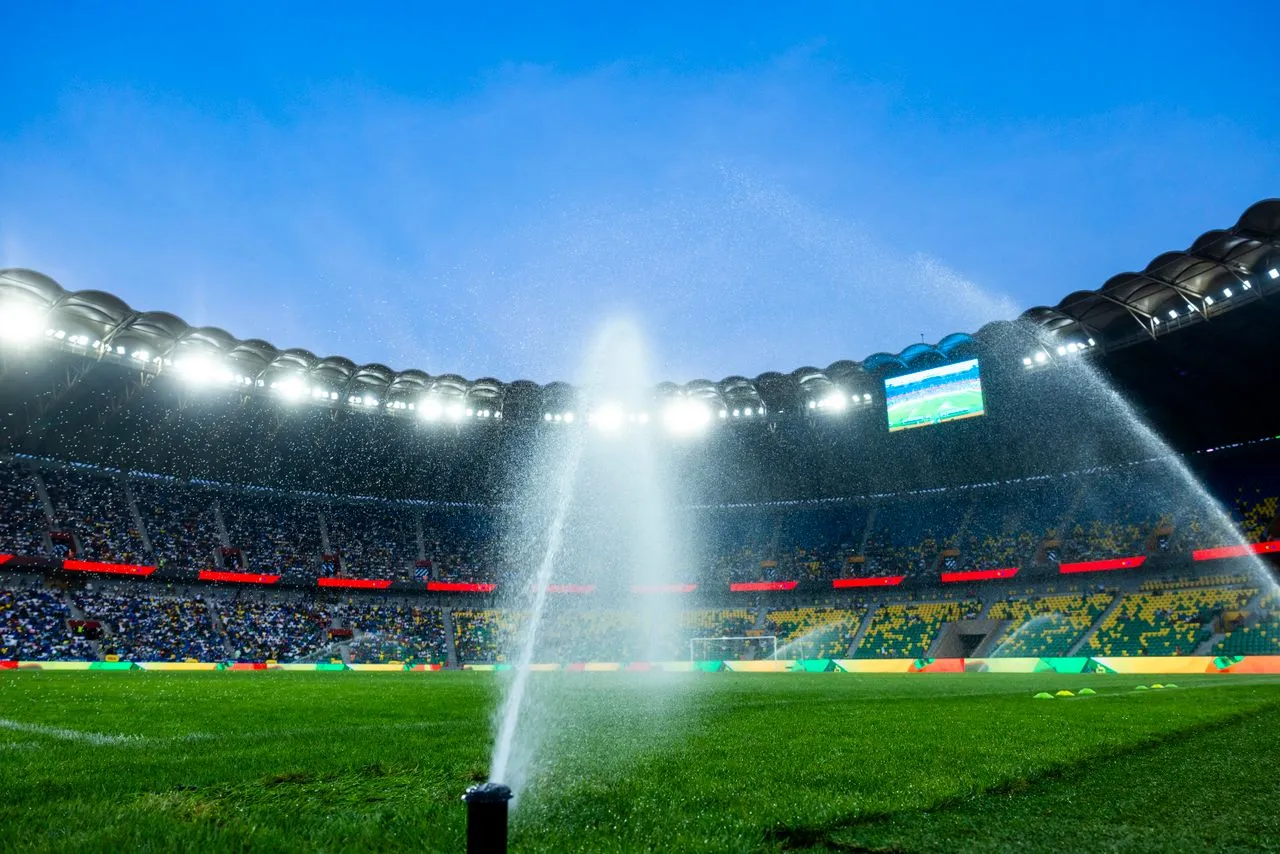
An irrigation system looks simple once it is finished: in the evening the sprinklers rise, work their way round and sink back into the ground. What you don't see is the calculation behind it. A system that was never designed but merely “put in” gives itself away in the first dry week of July — by the yellow rings between the sprinklers, and by the patches of lawn that stay permanently wet.
Why are pressure and flow measured before the design?
The first step isn't drawing, it's measuring the water source. Two quite different things are needed: pressure, which determines whether a sprinkler will perform as intended at all, and flow, which determines how many sprinklers can run at the same time. The mains supply in Srem often gives perfectly decent pressure, but the flow through an older domestic connection can be modest. A well with a pressure vessel is a different story — there you also have to look at the yield of the well, because a pump cannot draw more water than is actually there.
Skip this step and you get the classic mistake: on paper everything works, but out in the garden the sprinklers don't rise fully and throw noticeably shorter than designed. That is why the measuring is done on site rather than by assumption.
Why is an irrigation system divided into zones?
A zone is a group of sprinklers that runs together, off a single solenoid valve. How many zones there will be is determined first of all by the available flow — quite simply, how many heads the water can feed at once. But zones aren't worked out by arithmetic alone. They are also separated according to watering logic:
- lawn in full sun and lawn in the shade of the house or under tree canopies — their needs differ considerably;
- level ground and slopes, because water on a gradient starts to run off before it soaks in;
- lawn and planting — hedges, roses and flower beds want watering less often, but more deeply;
- different types of sprinkler are never mixed within the same zone, because they don't put water down at the same rate.
Which sprinklers, and at what spacing?
Rotary sprinklers are used on larger open areas: they turn the jet slowly and deliver water at a lower rate, which suits heavier, loamy soil that doesn't take water in all at once. Narrow strips, islands and corners call for fixed spray heads with a set fan-shaped pattern. Rotary nozzles, which throw several fine rotating streams, are a good compromise on medium-sized areas and are less affected by wind — no small thing out on the open plain.
Spacing is the one rule that isn't up for negotiation: the spray from one sprinkler has to reach the next one. This is called head-to-head overlap, and it sounds like overkill, but it isn't — every sprinkler puts down most water close to itself and least at the far edge of its throw, so uniformity is only achieved once the circles overlap. Spreading heads further apart “to save” is the commonest reason for a patchy lawn.
Beds and hedges get drip irrigation rather than sprinklers. The water goes straight to the root zone, the foliage stays dry, and that reduces fungal disease on damp nights in May and September.
How is an irrigation controller set up?
The controller switches the zones on one by one, to a set schedule. The best time here is early morning, roughly between four and nine o'clock — the wind is still, evaporation is at its lowest, and the foliage dries off by midday. Watering in the evening leaves the grass wet overnight and opens the door to disease.
Quantity matters more than frequency. During the season a lawn needs around 25 mm of water a week, rainfall included, and it is best given as two deeper waterings rather than a daily sprinkle. Frequent, shallow watering drives the roots towards the surface and leaves the lawn more vulnerable to the August drought. So the system isn't set “by feel” — you measure how much each zone actually delivers in a single pass, which is a job for the fine-tuning stage after commissioning.
A rain sensor is a small detail with a large effect: it interrupts the cycle once enough rain has fallen, so the system isn't running in a downpour. On heavier soil, cycle watering is also used — the same quantity split into two or three shorter passes with a pause between them, so the water has time to soak in instead of running off onto the path.
What affects the price of an irrigation system?
It isn't only the area that determines the scale of the job. It is also affected by:
- the number of zones — weaker flow means more zones, more valves and more distribution pipework for the same area;
- the shape of the plot — a broken-up garden with paths, islands and narrow strips needs considerably more heads than a rectangle of the same size;
- pressure at the source — if there isn't enough, a pump or a tank has to go into the system;
- access for machinery — where a pipe-laying machine can't get in, the trenching is done by hand;
- existing planting and lawn — threading pipe through an established garden is slower and more painstaking than working on bare ground;
- soil type — compacted loam and a gravelly layer don't dig at the same rate.
For all these reasons, a proper quote isn't given over the phone. The site visit and assessment are free, and the quote places you under no obligation: we measure pressure and flow, survey the layout, draw up a plan, and only then does the digging start. Once the work is done, each zone is fine-tuned. You can read how all of this works in practice on our irrigation systems page.
How is an irrigation system prepared for winter?
The system has to be drained before winter. First frosts in Vojvodina arrive as a rule in the second half of October, and over the winter the frost can penetrate deep enough into the ground for any water left behind to split a pipe or a sprinkler body. That is why the system is blown out with a compressor in the autumn, before the first harder frosts, and the main line shut off. It is a short job that protects the whole installation, and it forms part of seasonal maintenance. Verden, a landscaping and grounds-maintenance company based in Sremska Mitrovica, works across Serbia.